Care that fits the life you actually lead
The laundry basket is full. The drying rack is already doing a second job. Now someone suggests an elaborate care ritual for every delicate thing you own. We have a smaller starting point: read the label on the piece in your hand.
Care has to fit an ordinary home. That doesn't make the instructions optional, but it does make them useful information before you buy. If a garment needs a routine you know you'll struggle to maintain, the photograph isn't telling you the whole story of owning it.
Our fabric guide explains the names on the label. Our washing and storage guide takes you through what comes next. Neither can promise a piece will last forever. Both can help you trade a hurried guess for a more informed decision.
Fibre and construction tell different stories
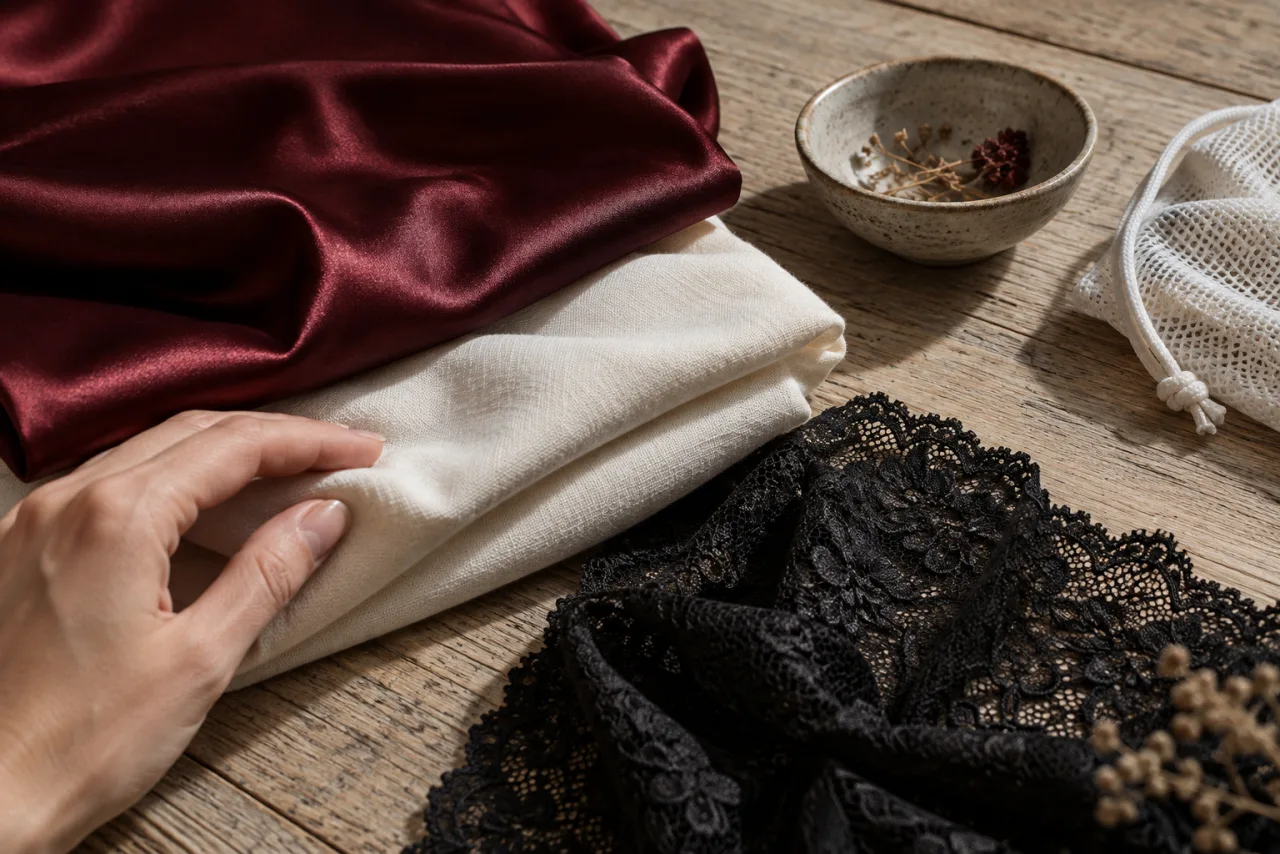
Cotton, silk and modal describe fibres. Lace describes an open decorative construction that can be made from different fibres. Satin describes a weave rather than a guarantee of silk. These distinctions matter because a fabric's familiar name may not tell you its actual composition or how the finished garment should be cared for.
A garment may also combine several materials. A lace panel, an elastic band, a lining and a fastening don't necessarily respond to handling in the same way. Follow the care instruction for the whole item rather than choosing a washing method from the fibre you recognise most easily.
Touch is useful for understanding preference: smooth, textured, crisp, soft or stretchy. It's much less useful as a substitute for a composition label. If you need to know what a piece contains, look for a written specification rather than trying to identify a fibre from a photograph or from how luxurious it feels.
Read the label before the laundry pile grows
The easiest time to check an unfamiliar piece is before its first wash. Look for the recommended washing method, temperature, drying instructions and any restriction on ironing or chemical treatments. If a symbol is unclear, consult the maker's guidance or an authoritative care-label reference rather than interpreting it from memory.
Keep a photograph of a label if you expect it to fade or if you decide to remove it for comfort. You can also note the instruction next to the garment's name. The system doesn't need to be elegant; it only needs to prevent a guess when you're sorting laundry in a hurry.
When instructions are missing, ask the retailer or manufacturer. A general guide can't confidently overrule a specific construction detail it can't see. An item with glued decoration, delicate trims or an unusual finish may need a different approach from a visually similar piece.
Build a small, repeatable routine
Sort the pieces that require different treatment before starting. Fasten hooks where the garment instructions allow, inspect for snags and give delicate items enough room to be handled gently. The purpose is to reduce avoidable friction and pulling, not to create a set of universal rules that ignores the label.
If machine washing is permitted, follow the recommended programme and any protective-bag instructions. If hand washing is specified, don't assume that vigorous rubbing is gentler simply because a machine isn't involved. Treat the garment according to its own guidance, including the detergent and drying recommendations.
Avoid improvising a remedy for a stain from a social-media tip without checking whether it suits the material and finish. A dramatic before-and-after photograph rarely tells you what happened to the elastic, dye or trim after repeated use. When in doubt, professional cleaning advice is more useful than escalating a home experiment.
Drying and storage deserve a little space
How a garment dries can affect its shape. Follow its instructions and avoid using extra heat simply to speed up the process. Arrange the piece so that its weight is supported rather than hanging from a delicate strap if the maker advises against that approach.
Put items away fully dry. A drawer should make them easy to find without repeatedly catching hooks on lace or crushing a formed cup. You don't need specialist furniture: a little separation, enough room and a consistent place for matching pieces can make everyday use more straightforward.
Storage should serve you, too. If an elaborate folding method means clean laundry never makes it back into the drawer, choose something simpler. A routine that's gentle enough for the garment and manageable enough for you is more useful than a display you can't maintain.
Notice when care is no longer the answer
Stretched elastic, exposed hardware, loose seams and damaged fastenings can change comfort. Inspect a piece when it starts behaving differently rather than assuming your body has suddenly become the problem. Sometimes a repair is possible; sometimes the garment has reached the end of its useful life.
A repair should be suitable for how the item is worn and washed. If you're unsure, ask someone with relevant sewing experience rather than adding a makeshift fix that might scratch or fail. The goal is a wearable garment, not preserving it at any cost.
If the piece is sound but no longer feels right, return to our fit and sizing edit. Care and fit overlap, but they answer different questions. Washing can't turn an unsuitable cut into a comfortable one.
Do delicate pieces always need hand washing?
The garment's own instruction is the starting point. “Delicate” is a broad description, and different constructions permit different methods. Avoid treating one rule as a substitute for every label in your drawer.
Is a higher price a guarantee of easier care?
No. Price doesn't tell you whether an item fits your routine. Check the care requirements before buying, especially if you've limited drying space or need a simple wash cycle.
What is the smallest useful change?
Read the labels on the pieces you wear most, then create one separate place for anything needing different treatment. That modest change can remove more guesswork than buying several new laundry products at once.