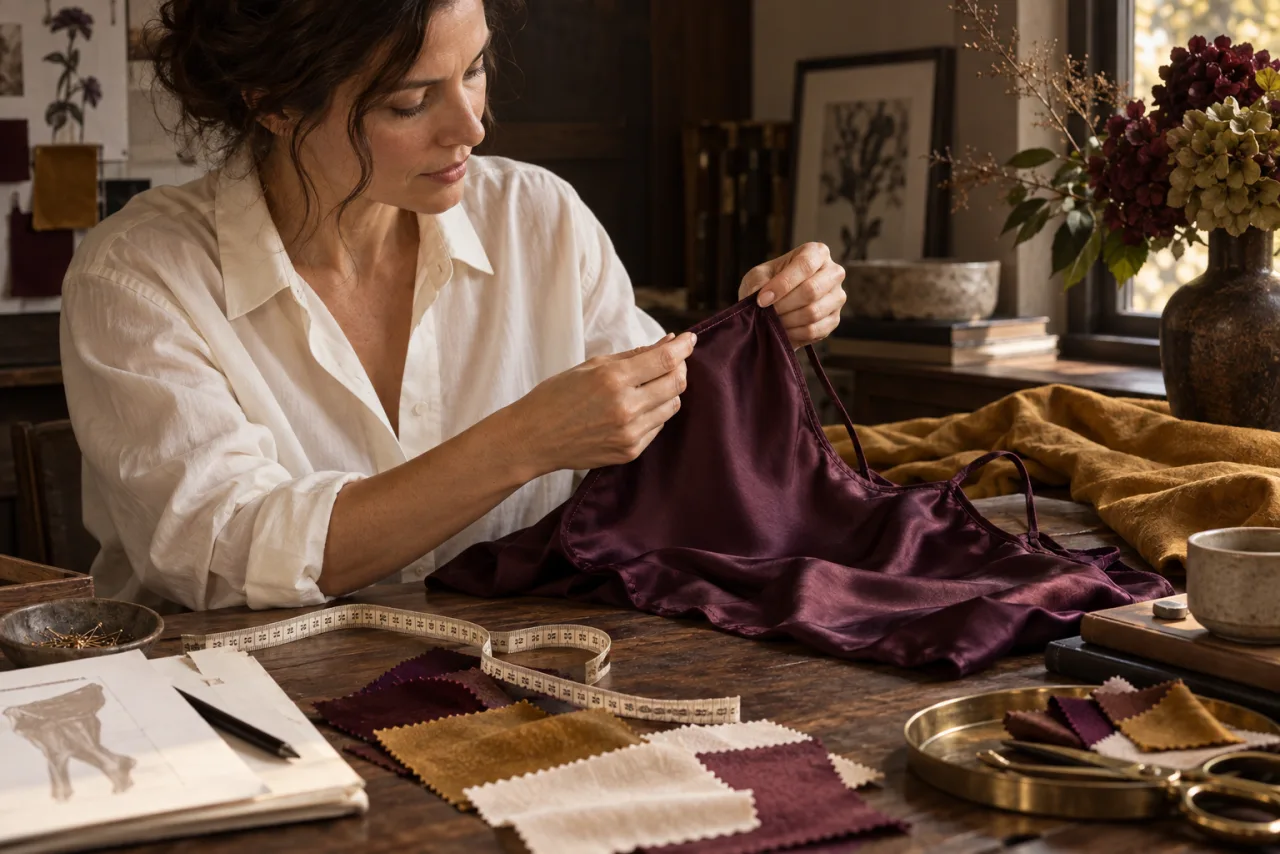
A good fit begins with an ordinary day
Try sitting down. It's an unglamorous fitting-room suggestion, but a useful one. A piece that feels fine while you stand still has more work ahead of it: a desk day, a walk, a reach into a high cupboard. Think about the day you want to wear it for.
The size on the label gives you a starting point. It doesn't describe every seam or tell you how much structure you'll enjoy. If two pieces with the same size feel different, you've learned something about those pieces. Your body hasn't failed a test.
This edit brings measuring and choosing shapes into the same conversation. Start with the question that's bothering you, and keep notes if they help. Finding one comfortable option is a perfectly good outcome; you don't have to turn it into a wardrobe project.
Measure to narrow the search, not to define yourself
A tape measure can make an unfamiliar size chart easier to navigate. It works best as a practical tool: use the method given by the brand you're considering, note the units, and check whether its chart uses the sizing system you expect. A number copied from another brand may not translate directly.
Our at-home measuring guide walks through the process and the checks that follow. Before you begin, find a mirror if you've one and take enough time to keep the tape level. If you get noticeably different readings, repeat the measurement calmly rather than choosing whichever answer you prefer.
Measurements also change. You don't need to keep wearing a size because it used to work, or buy a new size solely because a calculator suggests it. Bring the result back to the garment in front of you: how does the band sit, where do the edges rest, and what happens when you move?
Try the movements you actually make
Standing still in a fitting room only tells part of the story. Sit down, reach forward and lift your arms within a comfortable range. Notice whether you keep adjusting the garment or whether a seam becomes distracting. A piece that looks settled for a photograph may feel different after a few minutes of ordinary movement.
Make adjustments deliberately, one at a time. Changing the straps, band and position all at once makes it harder to understand which change helped. If you're constantly tightening a strap to compensate for a problem elsewhere, reconsider the overall fit rather than treating the strap as the answer to everything.
Comfort isn't a competition in tolerance. A mark or sensation that concerns you deserves attention, and persistent pain belongs in a conversation with a healthcare professional. You don't need to wait for a dramatic problem to decide that a garment isn't working for you.
Shape changes the experience
An unlined cup, a moulded cup, a bralette and a longline style distribute fabric and support differently. Those differences can matter more than the photograph used to sell them. Consider the neckline, the placement of seams, the depth of the cup and the amount of coverage you want under the clothes you already wear.
Avoid treating shape guides as instructions to disguise parts of yourself. If you prefer a certain line under a shirt, that preference is enough. If you like visible straps or a relaxed silhouette, that's also a valid starting point. The aim is to describe your options clearly enough that you can choose.
Our guide to silhouettes focuses on comfort and support rather than assigning bodies to a small set of categories. You can use it to name a feature you like, which makes future searches more precise than simply looking for something “flattering”.
Read the practical details before ordering
A useful product page should tell you more than the size and colour. Look for fabric composition, adjustability, fastening details and care instructions. Check the seller's actual return conditions before trying a new fit, especially where hygiene exclusions may apply. Flamme doesn't sell products or set any retailer's policies.
Think about the layer that will sit above the garment. A seam you enjoy in one outfit may be visible in another; a wide strap may work beautifully with one neckline and be awkward with another. Neither result makes the piece universally good or bad. It simply tells you where it belongs in your wardrobe.
If you can't find a necessary detail, ask the retailer or maker rather than guessing from an image. Editorial photographs on this website illustrate a subject; they're not evidence that we have handled or tested a particular product.
Keep the useful discoveries
A small fitting note can save time: the brand and style, the size tried, what felt right and what did not. Describe the feature rather than grading your body. “The edge presses when I sit” is more helpful later than “I looked wrong”. You can take these notes to a professional fitter if you choose to visit one.
Before replacing a piece, also inspect its condition. A worn elastic or damaged fastening can change how a once-comfortable garment behaves. Our fabric and care edit explains how to read care information and build a routine around the pieces you already own.
Does a different size mean I measured badly?
Not necessarily. Sizing systems and garment construction vary. Use measurements to locate a sensible starting range, then evaluate the actual piece. If a particular brand's method is unclear, its own fitting guidance is the most relevant place to ask.
Should every bra in my drawer be the same size?
The labels may differ because the designs and charts differ. What matters is that each garment works for its purpose and feels comfortable. You don't need matching labels to have a coherent wardrobe.
What is the best place to start?
Choose the one piece that causes the most everyday frustration. Identify a specific issue, read the relevant guide above, and change one thing at a time. A wardrobe gets easier through useful observations, not through perfect measurements.