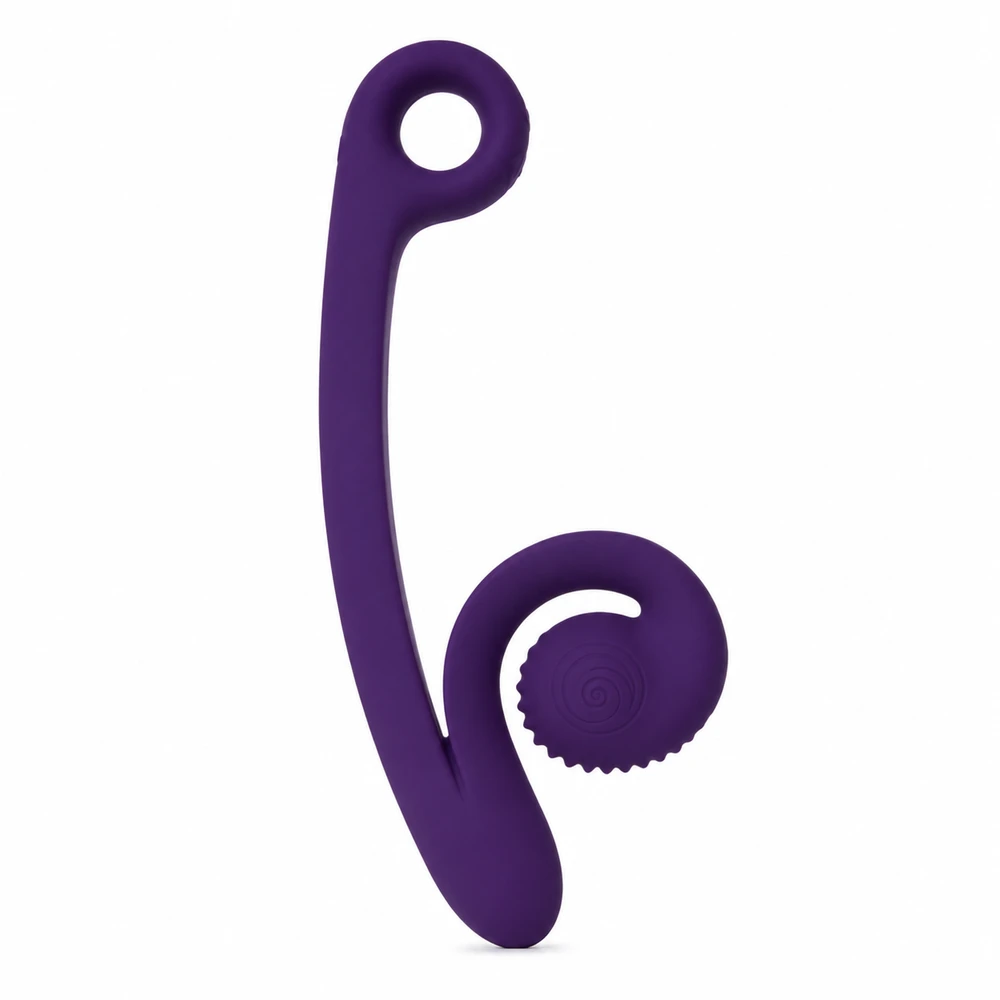
I’d put the Snail Curve on my shortlist if the external arm on a conventional rabbit never seems to stay where I want it.
The rolling contact head is a meaningful design idea, and the separate motor controls make the proposition more convincing.
I’d be less keen if my priority were a very flexible shaft, a small travel toy or long battery life.
That’s my buying opinion after comparing the current specification with independent reviews.
This review was commissioned for the SVibe campaign; I haven’t physically tested the Curve.
The product details were checked on 3 November 2026.
The part of the Curve I find most interesting
The Snail Curve pairs an insertable section with a coiled external head.
The coil opens as the device moves, changing the distance between the two contact points.
There are two independently controlled motors and a handle with a finger loop.
Those are the features I’d focus on before the number of possible settings.
A rabbit can look perfectly sensible in a photograph while asking your body to match one fairly fixed arrangement.
The Curve gives that arrangement some movement.
To me, that is a stronger reason to investigate it than a promise of a more dramatic result.
It addresses a particular complaint: having to choose between comfortable internal placement and useful external contact.
I still wouldn't interpret the shape as a fit guarantee.
The position you prefer, the pressure you want and the way you hold the handle all matter.
A moving joint can create options; it can’t tell you which option will feel right.
That distinction is easy to lose in a product video, where everything is already positioned neatly for the camera.
My first question would be whether I actually want both kinds of contact in one device.
If I only want external vibration, buying an insertable toy adds hardware I may rarely use.
If I already like a separate external toy, the Curve needs to offer a handling advantage worth changing for.
Novelty alone wouldn't be enough for me.
My quick comparison of the important details
These are manufacturer specifications and my interpretation, not measurements from a Flamme test.
The price is the US-dollar product-page reference observed on the research date, before destination-specific charges.
Scroll sideways to see every column →
| Detail | What I checked | How it affects my decision |
|---|---|---|
| Price | US$139 | Compare the amount payable, not the crossed-out discount anchor |
| Motors | Two, independently controlled | Useful if I want different settings internally and externally |
| Contact | Rolling external head plus insertable section | Worth considering for someone frustrated by fixed rabbit geometry |
| Handling | Long handle with finger loop | More to hold and more to store than a compact external device |
| Charging | Magnetic; around two hours stated | I would keep the correct cable with the toy |
| Runtime | Around one hour stated, depending on use | I wouldn't buy it for unusually long sessions between charges |
The control arrangement is the standout detail for me.
Two motors don't automatically mean two independently adjustable experiences.
Here, separate control gives the design a clearer purpose: you can vary one area without being forced to change the other.
That is a practical form of flexibility, even before deciding which intensity you prefer.
Amy's review describes separate pattern and intensity buttons for each motor, positioned above the finger loop.
The settings cycle in one direction.
I'd pay attention to that if I often want to step down a level without cycling through the rest.
The grip helps locate the controls, but doesn't remove the need to learn them.
What independent reviewers actually liked—and questioned
Amy’s Coffee & Kink review of the Curve is particularly useful because it connects the design to a specific body and preference.
She liked the consistent external contact, separate controls and motor feel.
Her reservations included the rigid shaft, limited runtime and vibration reaching her hand through the handle.
The sample was supplied by SVibe, and her article contains affiliate links.
I take that as a detailed individual assessment, not a verdict on everyone’s anatomy.
The encouraging part is that she explains why the mechanism worked for her.
The caveats are equally useful because they identify things the product photographs don't communicate well.
For example, a comfortable-looking handle can still transmit vibration.
I wouldn't turn her praise into my own hands-on claim.
What it does give me is a better shortlist of questions.
Do I usually dislike rigid insertable designs?
Am I sensitive to vibration in my hands?
Would I value motor independence more than compact size?
Those answers tell me more about the likely fit of this purchase than borrowing someone else’s numerical score.
There’s also a useful distinction between liking a mechanism and liking every part of the product.
I can see why the rolling head is appealing while still wanting a different shaft or a shorter handle.
That isn't indecision.
It's how I’d avoid paying for a clever solution to a problem I don't actually have.
Curve, Gizi or the VCD edition?
I’d choose between Curve and Gizi by thinking about handling first.
Gizi is the model I would investigate for a more compact arrangement.
Curve is the one I would investigate when a distinct handle matters.
Neither name tells me which will suit my body better, and the smaller option isn't automatically the easier one to position.
The Gizi specification describes two independent motors and no remote.
That makes it a useful comparison for someone who likes the basic dual-contact idea but doesn't need the Curve's extended grip.
I’d compare photographs from the side, not just the attractive front image.
The difference I care about is where my hand would go once the toy is in position.
The Curve VCD edition is a different sort of choice.
Its collaboration styling and package extras may appeal as a gift.
I wouldn’t assume a special colour means a more powerful motor or better fit.
If I liked the standard Curve’s appearance and found it at a lower total price, the edition label wouldn't persuade me to spend more by itself.
For a broader look at the category, our Curve versus We-Vibe Nova 2 comparison asks a different question: which approach to dual contact makes more sense for your preferences?
I’d read that before choosing based on brand familiarity.
The point of comparing is to find the design trade-off you're happy to live with.
What I'd check before paying
I’d start with the actual order total for the exact colour and destination.
On the research date, the Curve’s purchase block and another comparison block on the brand site didn't show the same price.
The amount at checkout matters more than an old paragraph, a search snippet or a promotional percentage.
I'd save the final specification and order confirmation so I know what I agreed to buy.
I would also check the delivery estimate for my address before treating the Curve as a time-sensitive gift.
Dispatch and arrival are different milestones.
A warehouse estimate doesn't tell me when a parcel will reach my door.
If the date matters, I'd want a destination-specific estimate rather than assuming the short message beside the cart applies everywhere.
The SVibe return policy is another part of the buying decision.
I'd read the conditions for my region before opening an intimate product.
A warranty and an opportunity to return something because the fit disappointed me are different things.
I wouldn't spend US$139 assuming that trying the Curve automatically leaves a change-of-mind return available.
That matters especially with this design.
The main uncertainty isn't whether a button changes a setting.
It's whether the relationship between the two contact points works for the person using it.
I’d want to be comfortable with that purchase risk before opening the package.
Care, charging and storage
The charging cable would get a labelled place in my storage setup.
Magnetic attachment doesn't establish compatibility with another cable that happens to look similar.
If I needed a replacement, I’d match the exact model through the brand's accessory listing or support team.
That's a small ownership detail, but it's more useful than collecting a drawer full of unlabelled leads.
For cleaning and storage, I would follow the supplied Curve instructions rather than borrowing advice for another SVibe model.
The coiled section deserves attention because it's part of the contact surface, not just decoration.
I’d look at how easily I can access it and let everything dry before putting the toy away.
A case is useful only if storing the product is straightforward enough that I actually use it.
I wouldn't buy the Curve expecting it to replace every other toy I own.
Its value is more specific: dual contact, adjustable motor settings and a handle that offers a distinct way to guide the device.
That could become a favourite combination for someone with the right preferences.
It could also be unnecessary complexity for someone happy with one external contact point.
Would I recommend the Snail Curve?
Yes, as a considered option for someone who wants dual stimulation and is frustrated by the fixed spacing of a traditional rabbit.
The independent controls and rolling geometry give me concrete reasons to recommend investigating it.
The external review evidence also gives me reasons to take the design seriously.
I'd pause if rigid shafts, hand vibration or a roughly one-hour stated runtime are already deal-breakers.
And if the real goal is a small external toy, I'd start elsewhere instead of hoping the Curve becomes something it isn't.
My recommendation is positive because of what this design offers, with fit and handling deciding whether it belongs on your shortlist.