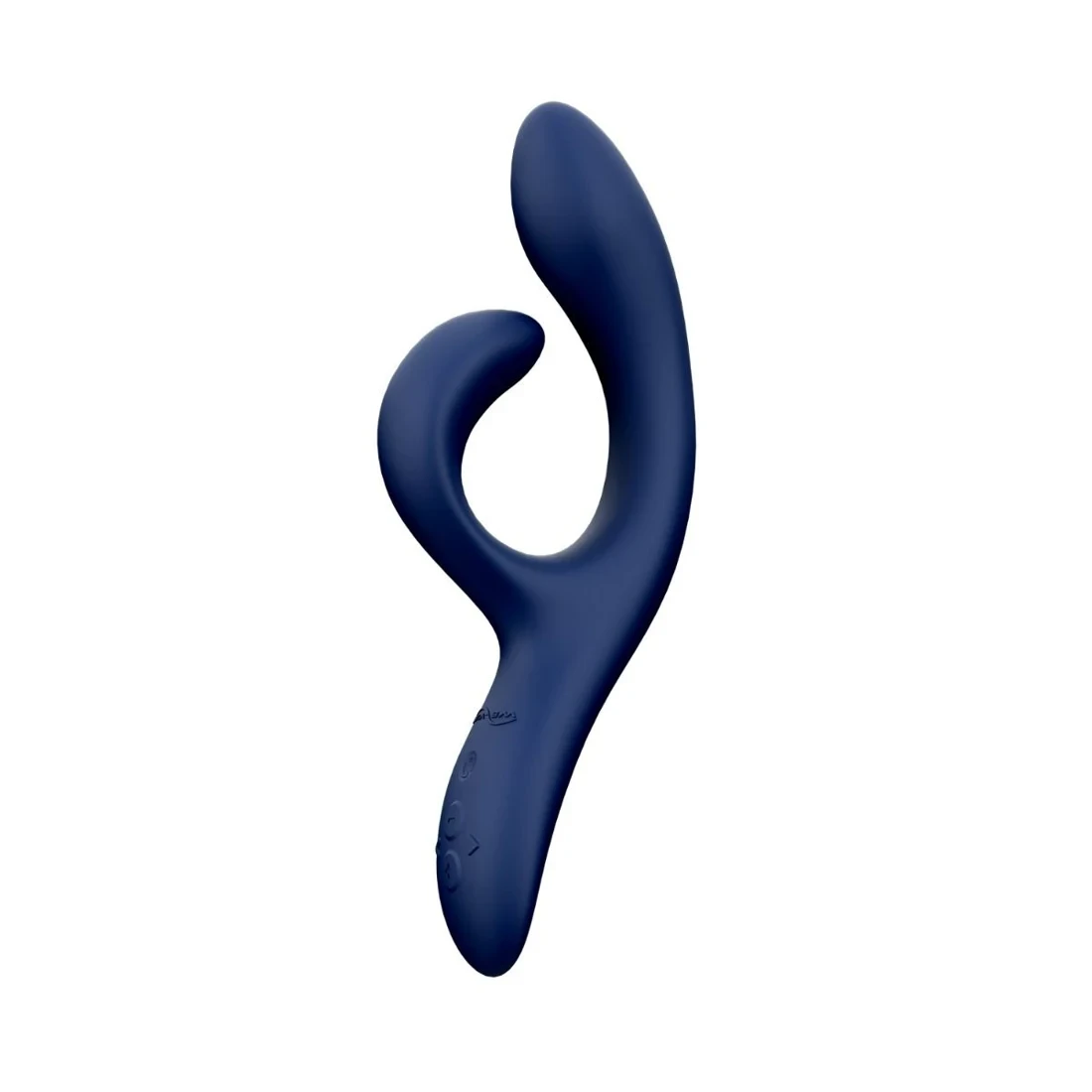
I’d look at Nova 2 if a rabbit’s fixed shape is the thing I want to change.
The adjustable internal arm and flexible external arm give me a concrete reason to stop and compare.
I’m less interested in adding another app to my phone than in finding a shape I actually want to hold.
That’s also where I’d be quite honest with myself.
Do I want two contact areas joined in one object, or would I rather position them separately?
If it’s the latter, I’d look beyond rabbits.
If the joined format appeals and adjustment is what’s missing, Nova 2 belongs on my shortlist.
The details I’d use to make the decision
The official Nova 2 page describes an adjustable internal arm, flexible external contact, We-Vibe app support and IPX7 water resistance.
It lists overall dimensions of 217 × 85 × 39 mm and manufacturer estimates of up to 120 minutes of use after charging for up to 90 minutes.
Those are published specifications, not our measurements.
Scroll sideways to see every column →
| Detail | Why I would consider it | What remains personal |
|---|---|---|
| Adjustable internal arm | More scope to investigate the angle | Whether that angle suits your anatomy |
| Flexible external arm | A different approach from a fixed rabbit | Contact and preferred pressure |
| Physical controls and app | A choice of control methods | Which method you will actually use |
| Rechargeable construction | No routine disposable-battery changes | Your charging habits and actual runtime |
The dimensions describe the object as a whole.
They are not interchangeable with insertable length, and a photograph cannot resolve that distinction.
Before buying, I would compare the manufacturer's diagram with the space and proportions I already know I prefer.
A long overall measurement can include a substantial handle; a small-looking photograph can conceal a shape that feels unsuitable.
The part of Nova 2 that interests me most
There is a meaningful difference between an arm that flexes during handling and one whose angle can be set.
Nova 2's appeal is that the design addresses both sides of the rabbit-fit question.
The internal position and external reach are related, but they need not be treated as a single unchangeable outline.
That would make it worth investigating if a previous rabbit almost suited you but its two contact areas did not line up comfortably.
It would be a less convincing choice if you disliked the entire dual-arm concept.
Buying a more adjustable example of a category you do not enjoy can still leave the same basic problem in your drawer.
I would also separate adjustment from force.
The manufacturer's manual is the reference for how the structure should be positioned; flexibility is not permission to bend any part indefinitely.
The practical question is whether the intended adjustment offers enough range, not whether the object can be made to resemble an entirely different product.
For someone buying a first rabbit, that distinction helps keep expectations realistic.
You are selecting a design with room for adjustment, not buying certainty.
A sensible return or satisfaction policy, confirmed for the exact retailer and country, can matter more than another promotional claim about universal comfort.
How much does the app add?
App control is useful when it supports a specific plan: sharing control with a consenting partner, changing settings on a screen or exploring the functions the current software provides.
If none of those interests you, I would judge Nova 2 mainly by its local controls and physical design.
For long-distance use, the toy-to-phone connection and the internet connection are separate parts of the experience.
The presence of Bluetooth on a product page does not mean that a partner's phone talks directly to the device from another city.
Check the current app instructions, compatible phones and connection process before treating remote use as the deciding feature.
I would do that setup in advance rather than turn an anticipated evening into a troubleshooting appointment.
Check how to disconnect, how local controls behave and how control returns to the person holding the device.
These are ordinary usability questions, not a prediction that the software will fail.
If distance is the reason for buying, I’d check the current app against the phones we’ll actually use.
I’d also want to understand how to end a shared session before starting one.
An old launch review can be interesting reading, but it wouldn’t settle those practical questions for me.
I’d look for recent accounts that name the phone and app version.
Controls and everyday handling
A product can have a good shape and still be awkward for a particular hand.
I would look closely at where the buttons sit relative to the grip, whether the important controls can be identified and how easily the device can be stopped.
The diagram and manual can help with that assessment, although they cannot replace physical experience.
Consider a simple hypothetical distinction.
One buyer wants to hold a stable setting and rarely touch a button.
Another changes settings frequently and cares about finding the right control without looking.
The same interface may be entirely adequate for the first and a much larger part of the second person's decision.
Runtime also belongs in this practical category.
An advertised maximum is useful for comparing a manufacturer's own estimates, but it is not a guaranteed number of sessions.
Settings, battery condition and usage affect the result.
I would not pay extra solely because one marketing table promises a few more minutes than another.
For storage, keep the correct charging cable and manual with the device.
A familiar-looking magnetic connector does not establish that a cable from another brand is compatible.
This is an unglamorous detail, but losing the right cable can matter more in daily ownership than the number of patterns printed on the box.
Cleaning and the limits of waterproof wording
The published IPX7 rating is a relevant feature, but the current manual should still govern cleaning and charging.
Water resistance does not mean every cleaner, temperature or charging situation is appropriate.
I would check the instructions for the entire object, including the areas around moving or flexible parts, before adopting a routine from another toy.
Our evidence does not establish a timed cleaning result or a durability score.
A simpler-looking surface may appear easier to inspect, but that is a design observation rather than a hygiene test.
Avoid turning reassuring material language into a claim that maintenance no longer matters.
I’d be quite happy to stop at a simpler answer: I don’t want this shape.
There’s no prize for making a format work just because it has a good reputation.
If I already know that separate pieces suit my preferences, I’d use that knowledge rather than start another purchase hoping an app will change the physical decision.
Where SVibe Snail Curve is a meaningful alternative
SVibe Snail Curve is worth comparing if you want to investigate a different external-contact design while staying with a handheld dual stimulator.
Its moving external contact is the reason to look at it.
Calling it an interchangeable Nova 2 would hide the very difference that makes the comparison useful.
I would keep Nova 2 higher on the shortlist when its adjustable rabbit structure and documented app support are the main attractions.
I would investigate Curve when the external contact itself is what I want to change.
Neither choice follows from which brand has the larger collection or the more enthusiastic homepage.
Curve also needs its own fit assessment.
A moving contact point does not guarantee better alignment, and a manufacturer's explanation of a mechanism does not establish that it will feel better to you.
The alternative should answer a concrete objection to Nova 2, not simply provide a second purchase link.
Our Snail Curve review examines that design separately.
Read it alongside the product dimensions and controls rather than treating the SVibe mention here as an overall ranking.
If you already have a comfortable rabbit and only want occasional app features, buying another device may not be necessary.
Would I put Nova 2 on my shortlist?
Nova 2 belongs on the shortlist for someone who wants a rechargeable rabbit, values adjustable geometry and can explain how they would use the optional app.
It is less persuasive for someone who wants only external contact, dislikes holding a larger device or expects a universally secure fit without experimentation.
Before choosing, I would resolve three questions: does the shape address a real preference, are the controls suitable for the intended user, and are the seller's terms clear for the actual destination?
A positive answer to those questions means more than an impressive maximum setting.
My verdict is therefore conditional but favorable: Nova 2 has a coherent design argument.
Buy into that argument only if adjustable dual contact is the thing you want.
If your real priority is changing the kind of external contact, compare Curve; if you want the two contact areas positioned entirely separately, broaden the search beyond rabbits.
Related reading
For a broader comparison, read SVibe Snail Curve vs We-Vibe Nova 2: Are They Worth It?.
For a separate assessment of another design in this range, see SVibe Snail Curve review: where the rolling design earns its place.
I’d choose the shape before choosing the software.
If Nova 2’s adjustment answers a frustration I can name, it’s worth a closer look.
If I’m more interested in changing the external contact itself, I’d compare Curve’s rolling head.
And if neither addresses what bothered me about a previous rabbit, I’d give myself permission to leave the category.
A new purchase should have a reason beyond making the drawer a little fuller.