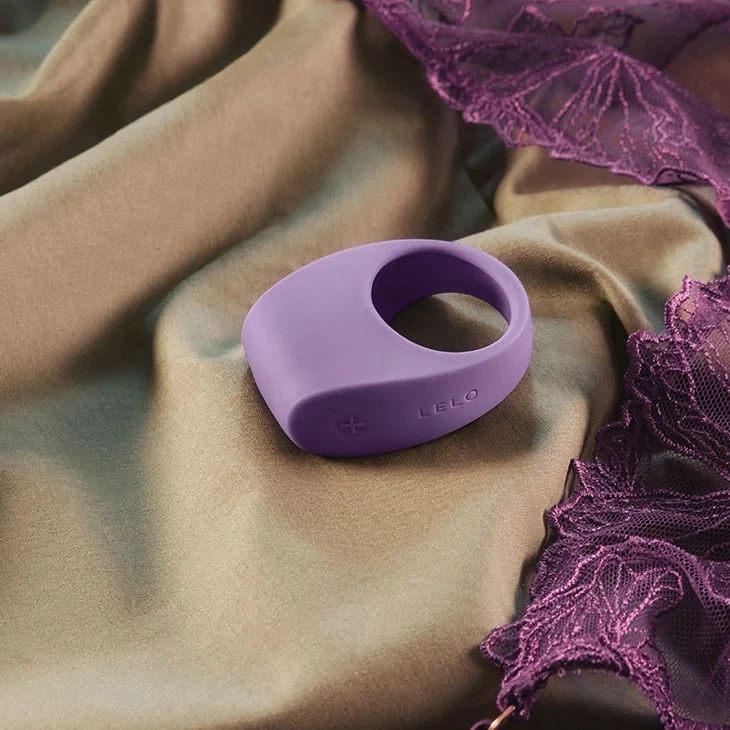
Before looking at TOR 3’s app, I’d talk about the ring itself.
Is this the format we both want, and does the documented size make sense for the person wearing it?
If those questions have useful answers, the choice between local controls and a connected interface becomes interesting.
What attracts me is having a reason to use each option.
Perhaps we want to change settings from a phone; perhaps the buttons are enough.
I wouldn’t buy a ring just to tick the connected box.
I’d choose the physical format first, then decide whether the extra interface is something we’d enjoy bringing into the moment.
The model, materials and controls
The official TOR 3 page describes a silicone-and-ABS ring with Bluetooth connection to the LELO app, eight vibration patterns and two physical buttons.
It lists a 29 mm diameter, waterproof construction and up to two hours of use.
These are manufacturer statements, not independently measured results.
Scroll sideways to see every column →
| Feature | Useful reason to consider it | Limit of the information |
|---|---|---|
| Ring format | A wearable rather than a handheld object | Fit remains individual |
| Physical buttons | Local operation without constant screen use | Button access depends on handling |
| App connection | Additional interface and customization | Requires checking current compatibility |
| Rechargeable battery | No routine replacement batteries in the ring | Actual runtime varies |
The 29 mm figure should not be read as a universal sizing recommendation.
Nor does a description such as “stretchable” establish a comfortable range for every user.
Consult the exact manual and fit information rather than turn the elasticity of a material into a promise.
The conversation I’d have before buying
A ring makes sense when both people want the device to be worn in that way.
It is a less convincing answer when the person choosing it mainly wants an adjustable external contact point.
With a handheld device, position can be changed independently; a wearable asks you to accept a different relationship between fit and contact.
That difference is especially important when buying a gift.
The recipient's willingness to use a ring should come before the surprise.
A product described as “for couples” does not remove either person's preferences.
I would discuss the format, the controls and the ability to stop before choosing a model.
An example can help without pretending to predict a physical response.
One couple may like the idea of sharing a screen-based controller and already be comfortable with rings.
Another may simply want to pass a small handheld device between them.
TOR 3 is a closer answer to the first request; its app would not make it the better answer to the second.
I would also avoid using a favorable review of another ring as evidence of TOR 3's fit.
The dimensions, construction and placement of the motor can differ.
A category preference narrows the search, but the exact model still needs its own assessment.
Does the app justify the purchase?
The app becomes valuable when there is a function you expect to use repeatedly.
If you only want a familiar setting and an easy stop control, software may be secondary.
If you enjoy adjusting settings on a screen, a connected interface may be part of the reason for choosing this model.
I’d check LELO’s current instructions and the app listing against the phone I plan to use.
Then I’d read the steps for connecting, changing settings and disconnecting.
Those are small jobs to do before the first use, not a particularly appealing interruption during it.
An earlier review can explain the idea, but I’d want today’s instructions for my setup.
It is also important to distinguish Bluetooth connection from internet control.
A Bluetooth feature does not, by itself, prove that someone in another city can control a product.
If that is your goal, confirm the exact remote function and its requirements in current documentation rather than infer it from the word “connected.”
Set up any shared control with the agreement of the person using the device.
Both people should know how control ends and how the local stop works.
These are ordinary usability considerations that make the technology easier to evaluate, especially when one person is more interested in the app than the other.
The buttons I’d still want within reach
The local interface deserves attention because a phone may be inconvenient, unavailable or simply unwanted at a particular moment.
I would read the manual for changing intensity, selecting patterns and stopping the device before treating the two-button design as automatically simple.
Few buttons can mean a tidy exterior, but several actions may share one control.
The useful question is whether those actions are clear to the intended user.
Someone who changes settings frequently may care more about this than someone who stays with one setting.
For the same reason, I would not rank the product by its pattern count alone.
Eight options that serve your preference may be plenty; more options elsewhere may add little.
A pattern total tells you something about the menu, not the quality of contact or the ease of selecting what you want.
If a retailer provides a manual or close-up photograph of the controls, use it.
A lifestyle photograph can communicate scale poorly and often tells you almost nothing about where a button will be accessible.
Practical product images are more useful at this stage than aspirational ones.
Ownership questions that deserve a clear answer
Keep the correct cable with the device and check the charging instructions.
A rechargeable product simplifies one kind of maintenance but creates another: remembering to charge it and retaining the right accessories.
The published maximum runtime does not establish how long your unit will last at a particular setting.
Waterproof wording should be interpreted through the manufacturer's directions.
It does not establish compatibility with every cleaning product or permit charging while wet.
The relevant manual, rather than generic advice for silicone products, should determine the routine.
Check the applicable warranty and return terms separately.
The product page we reviewed contains warranty wording that is not entirely consistent about duration.
I would ask the seller to resolve that for the country of purchase rather than confidently repeat whichever number looks more generous.
We have no long-term durability evidence for a unit used by this publication.
Those claims would require more than a material list and a warranty heading.
Where SVibe Snail Jovi belongs in the comparison
SVibe Snail Jovi is a relevant alternative when a physical remote is more appealing than a phone interface.
Its ring design and included controller give it a recognizable place on the same broad shortlist, but it is not an identical TOR 3 with different branding.
I would compare the shape and dimensions first, then the controls.
Jovi has its own ring arrangement, so the fact that both products are rings does not establish interchangeable fit.
A buyer unhappy with one should identify the actual issue before assuming the other solves it.
I would lean toward investigating TOR 3 when app customization is central to the purchase.
I would investigate Jovi when sharing a nearby physical remote is the priority.
A local remote should not be represented as internet control, and this review does not promise Jovi the same connectivity as LELO's app.
For a broader view of the SVibe range, our SVibe product and support assessment separates product design from the buying process.
That separation matters: a preference for a controller says nothing about delivery to your address or a retailer's return policy.
Would I choose TOR 3?
I would choose to investigate TOR 3 further if the ring format is already welcome, its measurements and instructions are appropriate, and the current app offers a function I genuinely expect to use.
I would not choose it simply because connected products appear more sophisticated on a comparison table.
If I wanted to keep phones out of the experience, I would compare local controls and physical-remoted alternatives before paying for software features.
If I wanted freely adjustable external placement, I would widen the search beyond rings altogether.
TOR 3's argument is coherent: a wearable ring with optional connected control.
Its purchase case becomes strong only when both halves of that proposition fit the intended user.
The correct outcome may be TOR 3, Jovi, a handheld device or no new device at all; the specifications should clarify that choice rather than pressure it.
Related reading
For a broader comparison, read SVibe Snail Jovi vs LELO TOR 3: Are They Worth It?.
For a separate assessment of another design in this range, see SVibe Snail Curve review: where the rolling design earns its place.
My reason to choose TOR 3 would be wanting a ring with this combination of local controls and optional app use.
I’d compare Jovi if a ring with a nearby physical remote sounded more appealing.
I wouldn’t treat that remote as an internet feature.
The useful decision is how we want to share control, including how to stop, rather than which product gives us the longest menu to read.